Shower rail or fixed shower head: which suits your bathroom?
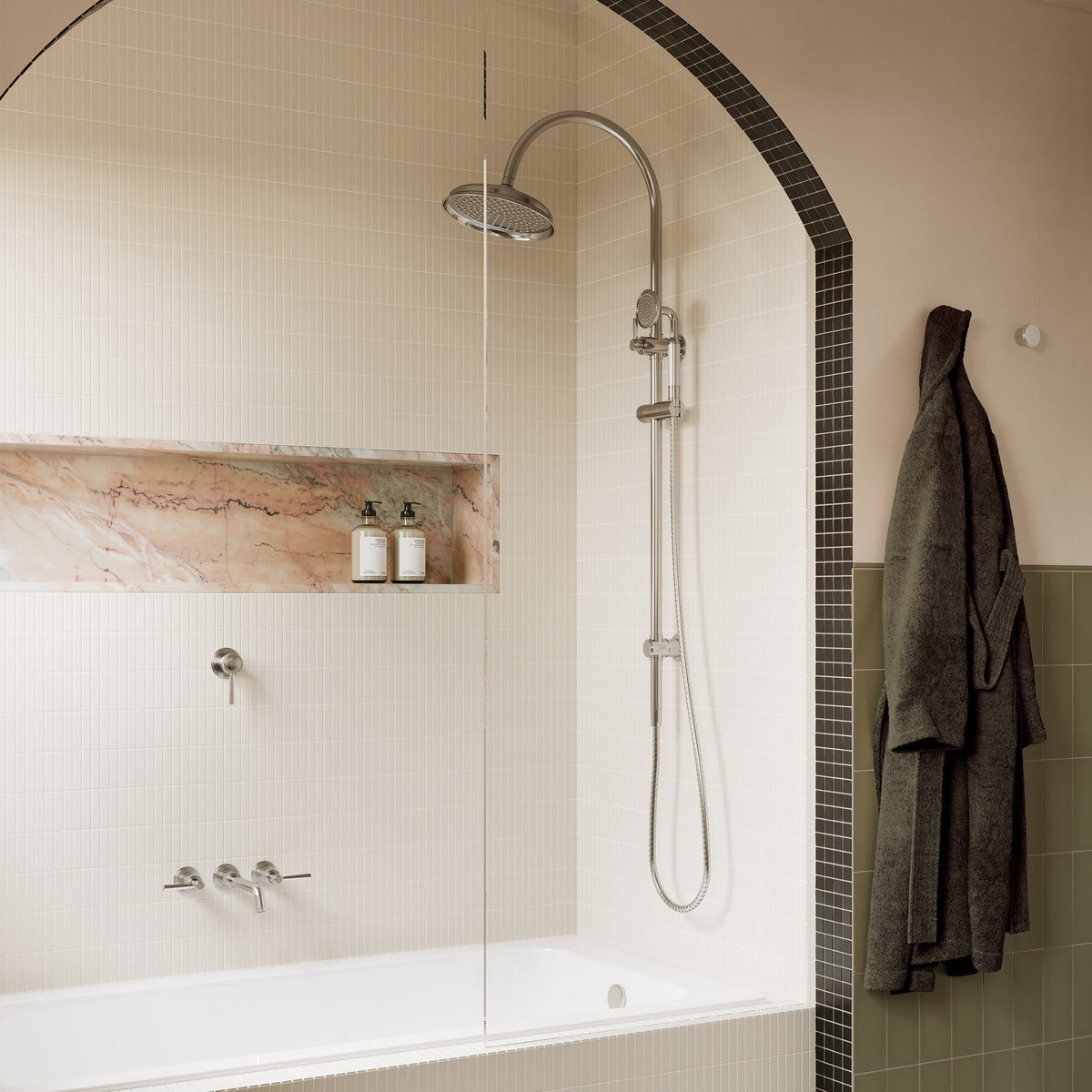
The shower is the fixture most people use every single day, so it pays to choose the type carefully. The two main options are a shower on a rail, where a hand shower slides up and down a vertical bar, and a fixed shower, where a rose sits on a wall arm or ceiling arm. Plenty of bathrooms now combine the two. Here is how they compare and what to sort out before the walls are tiled.
Rail showers
A rail shower has a hand shower that clips into a holder on a vertical rail. You can slide the holder to suit anyone in the house, or lift the hand shower off to rinse the shower walls, wash the dog or bathe small children.
Why people choose a rail
- Adjustable height. Tall and short family members can both get the spray where they want it.
- Easier cleaning. Being able to point the water at the glass and tiles makes the weekly clean faster.
- Accessibility. A hand shower is easier for anyone who needs to sit while showering. Look at our care and accessibility range if this matters for your home.
- Simple plumbing. Most rail showers connect to a single outlet, so they suit straightforward renovations.
Browse shower rails and sets, for example the Phoenix Wiltern Rail Shower.
Fixed shower heads
A fixed shower has a rose on an arm that comes out of the wall, or drops from the ceiling. Roses come in different sizes, commonly from around 200mm up to 300mm across, and larger roses give a softer, rain style spray.
Why people choose a fixed head
- A clean look. With no rail on the wall, the shower reads as minimal and architectural.
- Rain style spray. A large overhead rose gives that relaxed, drenching feel.
- Fewer parts to clean. There is no hose or rail to wipe down.
The downside is that the spray height is set when the arm is installed, and rinsing the shower walls is harder. See shower heads and shower arms.
Twin showers: the best of both
A twin shower combines an overhead rose and a hand shower on a rail. You can stand under the rose on a slow morning and use the hand shower to rinse off or clean. Twin showers usually need a diverter, either built into the shower set or in the wall mixer, so you can switch between the two. Have a look at the Phoenix Wiltern Twin Shower or the Meir round gooseneck shower set.
Choosing the mixer
Whatever shower you choose, you also need a mixer to control the temperature and flow.
- Standard wall mixer. One lever controls both flow and temperature. Suits a single outlet. See standard shower mixers.
- Diverter mixer. Lets you switch between two outlets, such as a rose and a hand shower, or a shower and a bath spout. See diverter mixers.
- Progressive mixer. Turns on at cold and moves through to hot as you rotate the handle, which some people find easier to use. See progressive mixers.
Many wall mixers are sold as a trim kit with a separate rough in body. Your plumber fits the body inside the wall before waterproofing and tiling, so the product page and specification sheet will tell you which parts are included.
Plumbing and set out to plan early
The shower is one of the first things your plumber needs to know about, because the outlets go into the wall long before the tiles. Decide these before rough in:
- Outlet height. For a fixed wall arm, the outlet height sets the spray height for good. For a rail, check the rail length and where the water inlet sits.
- Mixer height. It should be easy to reach before you step under the water, so you can test the temperature.
- Ceiling or wall arm. A ceiling arm needs plumbing through the ceiling space, which is easier to plan in a full renovation.
- Water pressure. Large roses need decent pressure to perform well. If your home has low pressure, ask us about roses and hand showers designed to work with it.
- WELS rating. Showers sold in Australia carry a WELS star rating that shows water efficiency. Read our guide to WELS and WaterMark.
Which should you choose?
For a family bathroom, a rail shower or a twin shower is usually the practical choice, because it adjusts to everyone and makes cleaning easier. For an ensuite used by one or two adults, a fixed rose can give a cleaner look. If you cannot decide, a twin shower covers both needs at the cost of a slightly busier wall.
Finish matters too. Match the shower to your basin mixer and accessories so the room reads as one. Our tapware finishes guide covers how to do that.
Common questions
Is a rail shower better than a fixed shower?
Neither is better in every case. A rail shower adjusts to different heights and makes cleaning easier, while a fixed overhead rose gives a cleaner look and a rain style spray. A twin shower gives you both.
Do I need a diverter for a twin shower?
Usually yes. A twin shower needs a way to switch between the overhead rose and the hand shower. Some shower sets have the diverter built in, otherwise you use a diverter wall mixer.
When should I choose my shower?
Before rough in. The plumber needs to know the outlet positions, mixer type and body before the walls are waterproofed and tiled.
Visit us or shop online
See the range in person at our showrooms: Geelong at 35A Ryrie St, Geelong VIC 3220, phone (03) 5223 2765, and Reservoir at 214 Broadway, Reservoir VIC 3073, phone (03) 9867 5051. Both are open Monday to Friday 9:30am to 5:00pm, Saturday 9:30am to 3:00pm, and Sunday by appointment only.
Planning a renovation? Request a quote and a free measure, and ask us to include installation by our qualified trades if you would like it quoted. Prefer to shop from home? Order online with Australia-wide delivery, or pick up from either showroom, usually ready in 2 to 4 days.
Keep reading

Floor wastes and linear drains: choosing the right shower drain
A guide to shower drainage: round and square floor wastes, tile insert wastes and linear drains, and how to choose for your tiles and layout.

Frameless shower screens: glass, hinges, brackets and handles
How frameless shower screens work, from fixed panels and hinged doors to the hinges, brackets and handles that hold them, and how to match finishes.

Ensuite renovation guide for Preston homes
A step by step guide to renovating an ensuite in a Preston home, from layout and showers to vanities, tiles, lighting and storage.